
About
Barnard is a unique small town
with a rich history and a bright future.
© Photograph Courtesy Seth Butler Media / Barnard Community Trust
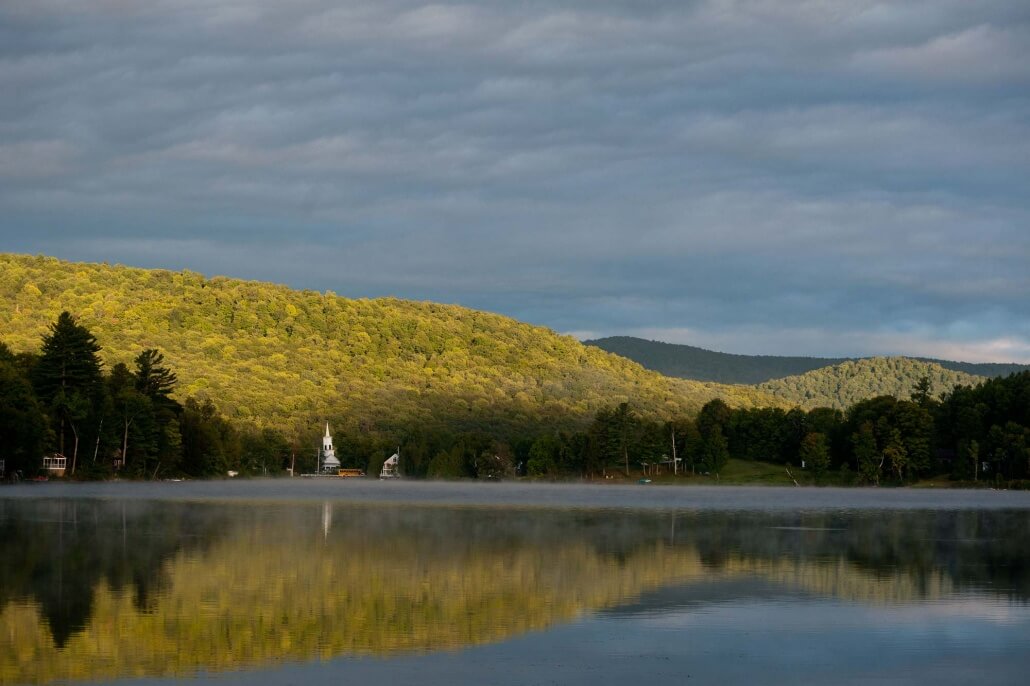
The village of Barnard is located at least a thirty minute drive from the nearest stop light and is nestled in the foothills of the Delectable Mountains. The elevation at village center is listed at 1,181 feet above sea level, which is one of the highest in Windsor County.
Barnard is situated toward the top of the Middle White River Watershed, approximately 15 miles Northwest of where the White River joins the Connecticut River, and is nearby the learned destinations of Vermont Law & Graduate School, Vermont State University, Dartmouth and Middlebury, while still close to the wooded heart of the Green Mountains.
As of 2020, a full-time population of 992 people lived in 442 of the town’s 704 housing units. Most of the houses that aren’t occupied by full-time residents are second homes or rental properties, a testament to the town’s popularity as a getaway destination.
Every season in Barnard brings familiar delights
to the community.
© Photograph Courtesy Seth Butler Media / Barnard Community Trust
Winter
During the short days of the long winter months, people gather at Silver Lake for pickup hockey games and to cut holes in the ice to drop fishing lines. The Barnard Mountain Viewers keep the town’s VAST network of snowmobile trails in good shape and the plow drivers stay busy keeping roads and driveways clear. Visitors travel from all over New England to enjoy nearby downhill and cross-country skiing opportunities. At long last, the daytime temperatures rise enough that the sap starts running in the maples, and the smoking stacks of the sugar houses remind neighbors that spring is near.
Spring
As the trees bud in spring, locals gather on the porch of the Barnard General Store to chat and watch as the fog lifts off Silver Lake. Tractors are tuned up and the fields are tilled. The hills and fields burst with green the roads get busy with cyclists, and the boat racks at the Barnard General Store fill again with canoes, kayaks, and paddle boards.
Summer
Summer brings a bustle to the town and lake. Silver Lake State Park is booked with campers, and the public lakefront across from the Barnard General Store is busy with sun-bathers and boaters and fishermen and swimmers. The Barnard Recreation Department supplies free equipment for tennis at the school. The Universalist Church, Barnard Inn, and Fable Farm host many a wedding. Outdoor music events begin and outdoor adventurers will explore the backroads on bikes, visit the conserved wildlands of the Chateauguay, or venture a little farther from the village to walk along the Appalachian Trail.
Autumn
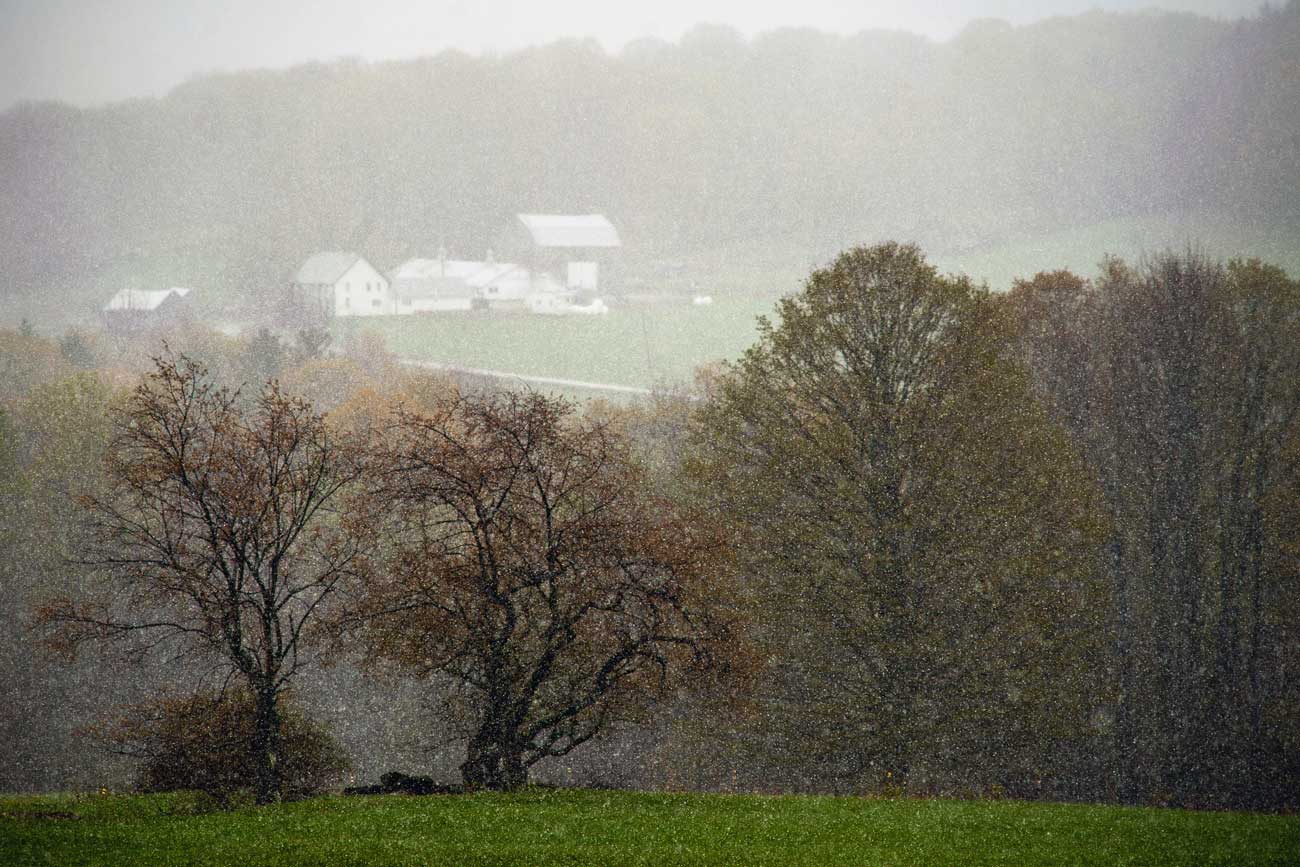
Autumn brings the leaf peepers, high school football at WUHS, harvest dinners, and, of course, hunting season. Locals start to think about the darker, colder months ahead. Neighbors help neighbors in need at the Barnard Helping Hands annual Firewood Fest, chopping and delivering wood to families who could use a little assistance in the colder months. Sometime around Thanksgiving the town will typically see its first snow. The holidays bring social gatherings and caroling at the village churches. And then, again, winter. And with it, the promise of another new year.
Barnard has a rich history.

© Photograph Courtesy Seth Butler Media / Barnard Community Trust
1761
On July 17, 1761, the town of “Bernard” was chartered by a New Hampshire grant, named after Sir Francis Bernard, the 1st Baronet and Governor of the Province of Massachusetts Bay.
History doesn’t recall why residents decided to change the name to Barnard, which is said to have occurred sometime before 1810, but it may have had something to do with the fact that Bernard rigidly enforced British policies as Governor of Massachusetts Bay.
1775
The first recognized permanent settlers in Barnard arrived in March, 1775. Thomas and William Freeman and John Newton were soon followed by the families of Lot Whitcomb, Asa Whitcomb, Nathaniel Page, Thomas Freeman, Jr., and William Cheedle.
1778
It was said that the boom of the cannons at the Battle of Bunker Hill in Boston could be heard in Barnard.
The first Barnard Town Meeting was held on April 9, 1778. The meeting was convened by the Committee of Safety for the Town.
1780
The town was unprepared for an attack in 1780 by a party of Native Americans, who captured Timothy Newton and two other Barnard men, dragging them all the way to Canada. Soon after, Fort Defiance was built on what is now Fort Defiance Hill in Barnard, a fortification that offered some protection to the village from such attacks from the north and east.
1801
In 1801, the Aiken Stand was built. Originally a tavern, the two-and-a-half story clapboard house was built along the turnpike that then ran from the Woodstock courthouse to the Royalton Meetinghouse. Roughly halfway between Woodstock and Royalton, the tavern and inn gained popularity with travelers. In 1817, President James Monroe stopped by the tavern, and in 1825, General Lafayette stayed at Aiken Stand on his way to Montpelier. Today, Aiken Stand is a private residence but can be seen and admired from the Royalton Turnpike at Sayer Road.
1832
In 1832, two buildings were constructed at the center of the village, both historic landmarks, though only one of which remains today. The Barnard General Store and the Silver Lake House were built right across Route 12 from one another.
The former is the store that remains the commercial and social heart of the community today; the latter was a hotel on the now-clear lawn between the General Store and the Universalist Church. The Silver Lake House thrived throughout the 19th Century, but was ultimately dismantled in 1937.
1837
The building that is now the Town Hall was originally a Methodist Church, built in 1837 and sold to the town in 1867.
1860
The Civil War left Barnard with perhaps its quirkiest historical artifact—Oliver’s Cave. Oliver Plaisted lived on Broad Brook in Royalton when the war broke out and, hoping to avoid service, he fled for Ellis Mountain on the Barnard-Royalton line. There he took refuge in a cave (chiseling “This is Hell” into a rock wall) and eventually built a tiny stone structure complete with slab roof. Both the natural cave with his carving and the stone refuge can still be found atop Ellis Mountain today.
1881
In 1881, the last catamount to be killed in Vermont was shot by Alexander Crowell. The large panther is now stuffed and on display at the Vermont History Museum in Montpelier and the rifle at the Barnard Historical Society.
And what about Silver Lake?
It was first called Stebbings Pond, after Benjamin Stebbings, who owned the land at the outlet. It was later referred to as Barnard Pond, before taking the name Silver Lake in the 1870s. Until at least the turn of the 20th century, grist and saw mills operated at the outlet of Silver Lake.
The first cottage on the Lake was built by Carl Cushing of Bethel in the late 1800s. Residents of Bethel and Pittsfield who “vacationed” in Barnard first developed Silver Lake Park on the eastern lakefront, the area now known as The Grove.
TURN OF THE CENTURY
Farming has been an integral part of Barnard life since the very beginning. Around the turn of the 20th century, many of the hills that are now covered with forests were cleared for planting and grazing.
As Lewis Cass Aldrich once mused of the then clear-cut landscape in The History of Windsor County, way back in 1891:
“But however hilly or mountainous may be the character of the land in this town, one thing at least is noticeable, and that, that the higher elevations are as susceptible of cultivation as the low or interval lands; and as one stands on the highway along the south side of Silver Lake there can plainly be seen for miles along the horizon well tilled farms with clearings and improvements, evidences of cultivation, even to the tops of the mountains.”
Since it was chartered, some products of Barnard have remained consistent: maple syrup, wood from the forests (once for mills, today more likely for home heating), and the dairy staples of milk, butter, and cheese. Throughout the 19th and 20th centuries, haying was a part of most Barnard residents’ summer lives.
1928
In 1928, best-selling novelist Sinclair Lewis bought 300 acres and a 1795-era farmhouse less than one mile east of Silver Lake. The story goes that the purchase was to satisfy an ultimatum laid out by his wife-to-be. Lewis had proposed to internationally-renowned journalist Dorothy Thompson, who promised to marry him only if he found and bought her a farm in Vermont. He did, and named the property Twin Farms. For more than a decade they lived, vacationed, and entertained political and literary figures from all around the world at their home in Barnard.
In 1930, Lewis became the first American writer to win the Nobel Prize for literature. Four years later, Dorothy had the distinction of being the first American journalist to be expelled from Nazi Germany as a result of her scathing commentaries about Adolph Hitler, whom she called “the very prototype of the Little Man.” The following year, at Twin Farms, Lewis wrote “It Can’t Happen Here”, a fictional account of America’s descent into a fascist dictatorship. The novel was largely inspired by Thompson’s reporting from Europe.
When they separated in 1938, Lewis deeded Twin Farms to Thompson, who retained the property until her death in 1961. Dorothy Thompson now lays buried near her third husband, Maxim Kopf, in the Barnard Village Cemetery on North Road.
1941
Lewis and Thompson aren’t the only famous writers to have called Barnard home. In 1941, German playwright Carl Zuckmayer, a refugee from Nazi Germany who Thompson had helped escape and settle in the U.S., moved to Barnard, and rented a farm in town for five years.
While in Barnard, Zuckmayer worked with the U.S. government to write profiles of Germans who were working with the Nazis. Before leaving Barnard to head back to Germany after the war, Zuckmayer wrote one of Europe’s seminal anti-fascist plays, The Devil’s General.
TODAY
In the decades since the great wars, Barnard has changed in many ways, and in others not at all. At some juncture, Route 12, North Road, and some of Stage Road were paved. The State Park on Silver Lake opened in 1955, as the mainstreaming of the automobile brought even more visitors to town.
Twin Farms became a modest inn and eventually a luxury all-inclusive resort. The town’s schools consolidated from seventeen in the 1850s to eight in the 1920s to four in the 1950s. By 1960, all of the town’s students attended Barnard Central School, which is now called Barnard Academy.
Yet, much of the charm from every era in Barnard’s history remains. The counter at the Barnard General Store. The bails of hay in the fields. Hunting season. Growing food. Folks gathering in the church to sing carols. The many dirt roads. Barnard today is a beautiful reflection of the town’s storied past, while the community shows how a small Vermont town can both preserve its soul and come to thrive in an ever-changing world.